Blog











Blog | 4 min read
August 4, 2026
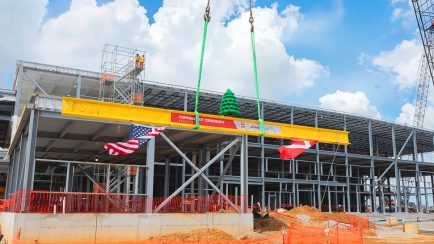
Greater Richmond has reached a historic milestone in its industrial real estate market. Despite being a mid-sized metro area, the region now ranks among the nation’s largest industrial construction markets, surpassing many larger competitors and reinforcing its emergence as one of the nation’s fastest growing destinations for industrial investment.
According to CoStar, Greater Richmond reached a record 13.8 million square feet of industrial space under construction in 2026 Q2, the highest level ever recorded for the region. The milestone reflects sustained confidence from developers and corporate investors, who continue committing capital investment to new manufacturing, logistics and distribution facilities across the region
Nationally, Richmond ranks as the 9th largest industrial construction market, trailing only major logistics and manufacturing hubs including Dallas-Fort Worth, Washington, D.C., Houston, Phoenix, Atlanta, Chicago and Austin. What makes Richmond’s performance particularly notable is its size. Every metro ranked ahead of Richmond has a substantially larger population and industrial base. When compared to metropolitan areas with population less than five million, Greater Richmond ranks 3rd for industrial square footage under construction, trailing only behind Columbus, Ohio and Austin, Texas.
Rather than experiencing a short-lived pandemic construction boom, Richmond has maintained a steady upward trajectory, adding new industrial projects throughout 2024 and 2025 — and now reaching a new record in 2026. Sustained growth suggests long-term confidence in the region’s industrial future, rather than temporary market conditions.

The chart below illustrates how consistently the region’s industrial pipeline has expanded over the past five years. Activity began accelerating in 2020 as manufacturers, logistics providers and developers responded to growing demand for modern industrial space. Although construction activity moderated between 2022 and 2023, new project announcements quickly reignited the market. By the second quarter of 2026, Greater Richmond reached an all-time high of 13.8 million square feet of industrial space under construction, marking one of the strongest industrial development pipelines in the country.
The region’s expanding industrial pipeline has been supported by a series of transformative corporate investments over the past five years.
Momentum accelerated with The LEGO Group’s announcement of its U.S. manufacturing facility in 2022, one of the region’s largest advanced manufacturing investments in recent history. More recently, Google committed an additional $9 billion in capital expenditures across Virginia, with significant investment supporting industrial development in Chesterfield County. Eli Lilly also selected Greater Richmond for a state-of-the-art pharmaceutical manufacturing facility, further strengthening the region’s position in advanced manufacturing and life sciences.
Combined, these projects demonstrate increasing confidence in Greater Richmond as a destination for large-scale industrial investment.
Industrial construction is a strong leading indicator of future economic activity. Developers typically commit to projects years before facilities are occupied, making today’s construction pipeline a reflection of future jobs, investment, and business growth.
Greater Richmond continues to attract industrial investment through several long-term competitive advantages, including:
With a record 13.8 million square feet of industrial space under construction, Greater Richmond is strengthening its position as one of the nation’s premier locations for advanced manufacturing, logistics, and supply chain investment. As companies continue seeking business-friendly markets with strategic access, available land and modern infrastructure, the region’s sustained development pipeline signals confidence in Richmond’s long-term economic future.
About The Author

Jenny Wharry, is the Research Manager for the Greater Richmond Partnership, where she leads data collection and analysis to support business attraction and economic development initiatives. Jenny holds a bachelor’s degree in economics from the University of Central Florida and a master’s degree in international business from the University of Florida, bringing a strong analytical foundation and practical research experience to her work.