News











Blog | 5 min read
February 3, 2026
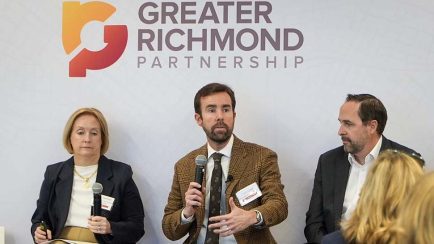
The Greater Richmond Partnership hosted a 2026 Forecast event focused on the future of site selection and talent perception of the Richmond Region. Regional leaders examined how these forces are shaping site selection decisions right now — and what that means for Greater Richmond’s competitive future.
The expert panel included:
Across the economic development profession, uncertainty is now a constant. As Domber summarized, “risk, volatility and multiple scenario planning are now the new normal.” Site selection consultants still value fundamentals of “a pro-business climate… (and) a workforce that’s ready to go,” as Chris Lloyd described, consultants are modeling against a faster, more volatile backdrop shaped by federal policy swings, tariffs and global shocks.
On the ground, economic development professionals are wearing more hats than ever. IEDC’s Nathan Ohle emphasized the widening scope that it’s “not just about bringing job creation and capital investment,” but also housing, childcare, crisis management and community development.
Policy instability has surged to a top concern, alongside “declining public trust” and more vocal “community activism.” This activism is often called by the acronym NIMBY-ism — Not In My Back Yard. The throughline, however, is that organizations that proactively engage their communities before a project is announced are faring better. As Ohle put it, “the one thing that communities really don’t want is a surprise.”
This moment is also prompting a healthy reset on metrics. Lloyd argued it’s “a long overdue discussion of how we define success” by moving beyond announced job numbers to include skills, quality of place and economic mobility. In short, the economic development field is stabilizing around a broader value proposition and Greater Richmond’s steady, diversified economy is a timely fit.
The latest State of Site Selection findings (co-produced by DCI and the Site Selectors Guild where Lloyd is a former chair) spotlight a decisive shift where infrastructure is now the new gatekeeper. Communities that lack utility capacity, power reliability, site preparedness and speed-to-market are eliminated early – sometimes without even knowing they were in consideration. As Domber noted, if you can’t meet infrastructure and workforce thresholds, “you’re going to be out of the conversation before you even get asked to participate.”
Lloyd offered a candid assessment of near-term constraints and competitive edges for his hometown. On strengths, Richmond’s predictability, talent quality and industrial momentum stand out. The region is “a value driven location” in the right peer sets, with competitive plays in target industries such as manufacturing (including food & beverage), high‑performance electronics, the data center supply chain, life sciences, logistics and corporate headquarters. Crucially, the market’s resilience is a differentiator: “We don’t have those boom-bust cycles… we’re predictable, we’re steady.”
The path forward includes accelerating site readiness, expanding air connectivity and continuing the storytelling needed to stand out amongst competitors. As Lloyd reminded the audience, “If we don’t tell our story, no one will. Economic development is a relationship business and it’s about telling stories.” With perceptions rising among consultants and executives, and aligned leadership across GRP and regional partners, Greater Richmond is well positioned to convert today’s momentum into tomorrow’s wins.
As much of the nation struggles to find solutions to workforce issues, Greater Richmond is starting a talent attraction initiative. That first step is gaining a baseline for how potential workers perceive the region as a relocation destination.
DCI’s new talent perception research delivers a clear takeaway: Greater Richmond’s challenge isn’t performance — it’s perception. As Robyn Domber noted, the region’s “biggest barrier to attracting and retaining talent really is not about performance, but it is about perception.” The story Greater Richmond community tells about itself simply isn’t reaching enough relocation candidates. Even for a growing community such as Greater Richmond, that’s both a challenge and a massive opportunity.
On fundamentals, Richmond scores well on what workers say they must have to move: “health care, housing availability, [and] cost of living” are all positives — though Domber cautioned the responses are “a little more moderate than what we’d like to see.” The quality-of-life definition has evolved, too. Instead of nightlife and amenities, today’s movers prioritize “financial stability, access to health care and mental care resources” and a standard of living where they can thrive.
The data also underscores a crucial behavior: “67% of individuals will not relocate without a job in place.” That’s why clear, persistent job-market messaging matters, especially around long-term growth. Right now, Domber explained, “there’s sort of a lack of confidence that talent can advance in their careers,” and as a place to work, the prevailing sentiment is “unknown.” The good news is when an offer aligns to skills and salary, “a full 55%” of respondents would consider relocating to Greater Richmond, with another 24% open to the idea.