









Change language to Arabic Change language to Chinese (Simplified) Change language to Dutch Change language to English Change language to French Change language to German Change language to Italian Change language to Japanese Change language to Portuguese Change language to Russian Change language to Spanish

News | 6 min read

Why are Hanover County tomatoes famous?

July 21, 2026

Hanover Tomatoes in Virginia tourism

Farmers and experts say the secret is rooted in both tradition and science.

Every July, thousands of people descend on Pole Green Park in Hanover County for an event that celebrates a fruit so beloved that locals rarely feel the need to explain its reputation.

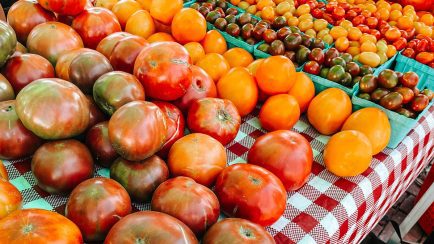
Hanover tomatoes have become one of the commonwealth’s most recognizable agricultural products at roadside stands, on seasonal menus and among generations of Virginians who insist they simply taste better than tomatoes grown anywhere else.

The annual Hanover Tomato Festival has helped cement that reputation since it began in the 1970s as a fundraiser for the Hanover County Volunteer Fire Department.

The event has grown into one of Central Virginia’s largest summer festivals, drawing out-of-state visitors — and even former presidents — eager to sample fresh heirlooms, beefsteaks and tomato-centric recipes.

Beneath the celebration lies a question that has lingered in the minds of outsiders and even some locals: What actually makes Hanover tomatoes so special?

Ashland Supervisor Faye Prichard said it’s the variety that sets Hanover tomatoes apart from the rest.

“Tomatoes are tomatoes, but Hanover tomatoes have a little bit more depth, a little bit more signature flavor,” Prichard told VPM News. “Especially those heirloom tomatoes. Those are the ones, and we’ve got them on every farm stand in Hanover. The best ones are in my backyard.”

Rachel Wood, of Rachel Wood’s Freeze Dried Goods, told VPM News she didn’t know the answer as she peddled freeze-dried cherry tomatoes from her stall last Saturday.

“I don’t know the secret, I don’t know,” Wood said. “Can you tell me?”

Rachel Wood, of Rachel Wood's Freeze Dried Goods, laughs on Friday, July 10, 2026, at the Hanover Tomato Festival in Hanover County, Virginia.
Rachel Wood, of Rachel Wood’s Freeze Dried Goods, laughs on Friday, July 10, 2026, at the Hanover Tomato Festival in Hanover County, Virginia.

First, the science

Scot Ferguson pointed to the county’s soil and climate.

As an agriculture and natural resources agent with Hanover’s Virginia Cooperative Extension office, he helps educate the community on issues around sustainability and agriculture. He said there is real science behind why fruit and vegetable plants thrive across the county.

“The east side has really good, well-drained, loamy soils that are actually excellent for vegetable production,” Ferguson said. “It can hold a lot of nutrients because it’s a fine soil and those types of soils are really good and super productive, especially [for] stuff like tomatoes.”

Ferguson said loam soils drain efficiently while still retaining enough moisture and nutrients to support healthy root systems. Still, he’s careful not to oversell the idea that one magical ingredient makes Hanover tomatoes unique.

Early accounts of a United States Department of Agriculture soil survey conducted in1905 claim Hanover produces “excellent quality” tomato crops.

“What I really like about Hanover is that you have all these farms, but there’s kind of this integration with the different types of natural landscape too,” Ferguson said.

Hanover’s geography contributes to its agricultural wealth, as the thin slice of territory rests on a geological boundary known as the Fall Line — a barrier that separates soft sediments of the Coastal Plain from the Piedmont region’s hardened bedrock.

The county is also bordered by several rivers, including the Pamunkey and North Anna River to the northeast and the Chickahominy to the southeast. They’re good sources of irrigation that enrich the silt, sand and clay-mixed soil.

A common story locals tell is that Hanover’s soil was enriched by volcanic ash deposited millions of years ago, when dinosaurs roamed and ancient volcanoes erupted.

Ferguson didn’t outright refute that claim. But he reiterated that the area’s naturally productive soils were formed through millions of years of geological change. Virginia does have a bit of a volcanic past: Two known volcanoes, in Rockingham and Highland counties, were active millions of years ago.

Cut Hanover tomatoes are seen on a plate on Friday, July 10, 2026, at the Hanover Tomato Festival in Hanover County, Virginia.

Tomatoes alone don’t pay the bills

Jeff Sears’ family has had a vegetable farm just outside of Ashland for five generations. Every summer, customers ask him the same question: Why are Hanover tomatoes different?

“I’ve heard it my whole life,” Sears told VPM News. “What’s the difference between a tomato here and a tomato there? Stuff grows good in different areas, but what makes Hanover special for tomatoes?”

Sears’ farm is primarily known for its tomatoes, but that’s not his main source of income. He makes a living with a mix of farming crops, raising livestock and hosting events on his property.

Every season brings another opportunity to continue the work of previous generations. But farm life has drastically changed since Sears’ family first began selling produce by the roadside.

“If I just farmed, I wouldn’t be able to pay the bills,” Sears said. “And it’s just bad because everything in the past has doubled, if not tripled, but your price of produce. What we sell hasn’t.”

Hanover farmers, like many across the US, face rising production costs, unpredictable weather and increasingly narrow margins. While the tomatoes are the star of the show, Sears said, they’re labor-intensive, requiring careful planting and harvesting over several weeks.

Ferguson said that kind of unbroken dedication to the crop may be the real recipe for Hanover’s success: “The way I look at it is that everything in agriculture that we do is really about history and tradition.”

Unlike commodity crops like corn, soybeans and wheat — things that often disappear into larger supply chains — Hanover’s staked its reputation on tomatoes through years of trade, word of mouth and spectacular marketing.

Ferguson argued Hanover could just as easily have become famous for another crop. Instead, farmers consistently grew quality tomatoes for decades, and customers kept coming back.

“If things had gone differently, we might be talking about Hanover tobacco,” he said. “It’s kind of cool how people figure out what’s really marketable, what can grow well there.”

That’s how tomatoes continue to occupy an outsized place in Virginia’s culinary identity. And that’s just fine for Sears, who’s happy his family has gotten to be part of it for so long. He hopes the next generation will continue the tradition after he’s finished.

“I’m just glad we’re in Hanover and we grow tomatoes,” Sears said.

See the story on VPM News.

About The Author

Lyndon German covers Henrico and Hanover counties for VPM News. As a Mechanicsville native and graduate of Virginia Commonwealth University, he hopes to bring a firsthand perspective of the challenges each locality faces.

Prior to joining VPM News, German has been a part of several award-winning news organizations, including the Richmond Times-Dispatch, The Virginian-Pilot and The Progress-Index. Outside of journalism, he enjoys biking, reading and the occasional chess match.