Blog


Blog | 5 min read
October 22, 2026
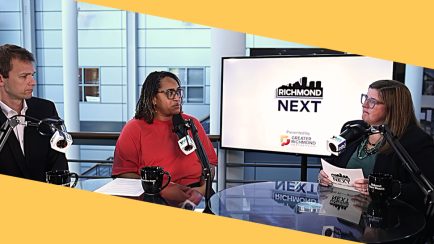
“We are finally at a place of being willing to embrace the things that may change who we are as a region,” says Rasheeda Creighton, Executive Director of BLCK Street (formerly the JWC Foundation), a community nonprofit supporting Black business owners. On Episode 3 of Richmond Next, a Greater Richmond Partnership (GRP) series produced in partnership with the Richmond Times-Dispatch, GRP President & CEO Jennifer Wakefield sat down with Creighton and Joe Kane, Senior Director of Research at GRP, to discuss GRP’s new regional data dashboard, launched in May 2026. The conversation explores what the data shows, what it can’t and how data, AI and community
Strong economic development doesn’t start with a pitch deck; it starts with understanding a region well enough to know where support is needed most. Creighton frames data as part of the natural fabric of running any organization: understanding regional trends is what shapes customer strategy and business development on a day-to-day basis.
Kane builds on that idea by highlighting the narrative that stems from the numbers. Research has a reputation for being “this wonky data sort of exercise,” he admits, but a researcher’s true job is to tell the right story and get it in front of the right audience. For a region trying to attract talent and investment, data is the foundation, and telling its story is what turns it into strategy rather than a simple report. At GRP, that story now has a home online.
That home is GRP’s new regional data dashboard, a free, publicly accessible, interactive tool launched as part of GRP’s new strategic plan. It tracks 28 indicators across five categories: economic impact, population, regional economy, transportation and real estate — giving site consultants, business owners, policymakers and residents a holistic, evidence-backed view of the region.
Having that much data in one place is valuable, but the dashboard’s AI assistant is what turns a dense dataset into something usable in the moment. As Kane puts it, “If someone has a basic question, they don’t have to go rooting through a bunch of different tabs or data.”
Beyond the dashboard, national research offers a wider view of how the region is performing. Kane, who previously worked on Brookings Metro’s Metro Monitor, says Richmond has performed strongly over the past decade on opportunity (the quality of growth) and inclusion (how broadly that growth is shared). He also points to Richmond’s consistency — the steady growth and stability that builds market confidence.
That combination is harder to pull off than it sounds, since regions commonly trade one for the other. For a mid-sized metro competing against larger, better-resourced ones, it’s a genuine differentiator that ties directly to factors weighed in site selection, such as workforce inclusivity and community stability. For Creighton, inclusion means looking beyond the numbers to understand where communities and businesses still need support. The same is true at the regional level: looking past the averages to see who is growing and who isn’t “will help us understand if we need bridges in certain places,” she says.
Strong regional and national numbers are good news, but they also raise a crucial follow-up question: Who is participating in that growth, and who isn’t? That’s where Creighton’s perspective comes in. Macro-level indicators are essential, but they can only say so much about a region’s health. A region’s economy may appear healthy on the surface while hiding uneven outcomes. That distinction matters greatly for economic development work aimed at creating broad-based growth rather than growth concentrated in a handful of sectors. As Creighton puts it,
“A strong indicator of economic sustainability on the macro level doesn’t necessarily mean that the place where I take my dog to get groomed is doing well.”
Rasheeda Creighton
Executive Director BLCK Street
That’s the gap organizations like BLCK Street are striving to bridge, and it shapes how they work with the business owners they serve. Much of the work isn’t answering the questions people ask but helping them figure out what to ask in the first place. “You don’t know what you don’t know,” Creighton says, and nine times out of 10, the problem is “a symptom of a deeper root cause.”
Taken together, Kane and Creighton’s answers cover both halves of inclusive growth: the momentum and the distribution of that momentum.
With both halves in view, the question becomes: Where does the region go from here? Both Kane and Creighton see real reasons for optimism over the next 5 to 10 years, though their optimism comes from different places. Creighton returns to the idea she opened with — a willingness to embrace the things that may change who we are as a region, which she sees as a sign that Greater Richmond is ready for real transformation. Meanwhile, Kane describes something hard to quantify but impossible to ignore: an energy around Richmond and a shared belief that people are part of what’s happening, not spectators of it. “It isn’t just exclusive to one part of the region,” he says. “It feels really kind of infectious in a lot of ways.”
Together, their optimism points to what the series is built to showcase: hard data showing consistent, inclusive growth, paired with community organizations working to close the gaps that data alone can’t see. At GRP, that combination is what sustainable regional economic development looks like, and it’s what will keep Greater Richmond competitive in the years to come.
Watch Creighton and Kane on YouTube
Watch the full interview: Richmond Next