Blog











Blog | 4 min read
October 12, 2026
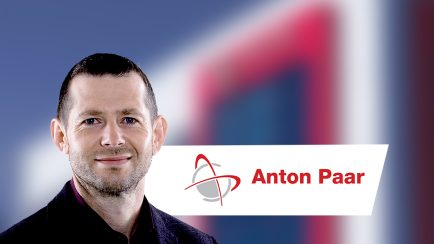
Reinhard Eberl oversees Anton Paar’s business across the entire Western Hemisphere from Hanover County, Virginia. In a time of global uncertainty, Eberl provided his take on why Greater Richmond continues to succeed and how it’s less about cost-cutting and more about resilience on a recent episode of The Richmond Next video podcast.
Founded in 1922, Anton Paar is a high-precision laboratory instrument manufacturer headquartered in Graz, Austria, with about 5,000 employees and 40 sales and service subsidiaries worldwide. Its Hanover County location serves as Anton Paar’s U.S. and Americas headquarters, overseeing more than 400 employees in the United States and coordinating a total workforce of approximately 800 employees across the Americas, from Canada to Argentina and Chile.
Logistics: Most of Anton Paar’s instruments ship from manufacturing sites in Austria, Germany and Switzerland. From there, goods reach Greater Richmond in only three business days — an unusually fast turnaround for shipments arriving from Europe.
Time zone: Richmond sits within a perfect six-hour window of its Austrian headquarters, two hours behind Brazil and Argentina, and three hours ahead of the U.S. West Coast. This is a true advantage when European and South American clients alike need someone available during their business hours.
Connectivity: From Richmond, Anton Paar’s team can reach São Paulo, Buenos Aires and Bogotá, usually through one connection, without paying the cost of locating in a major metro area.
Eberl’s outlook on the region tracks closely with where we’ve been pointing Greater Richmond. “We have made great progress in advanced manufacturing,” he said, “and if we look into life science or pharma, we are making huge progress.” Anton Paar’s precision instruments sit right at the intersection of those two industries. It’s the same cluster strategy behind wins like Haleon’s $54.2 million investment to modernize and expand its R&D “Center of Excellence” in Richmond and the LEGO Group’s $1.04 billion carbon-neutral plant in Chesterfield.
Geography matters more in a time like this. Eberl doesn’t sugarcoat how tough the current environment is. “Times are quite challenging right now,” he said, “and it’s not just about efficiency anymore, it’s also about resilience.”
Part of that challenge is concrete: with only one U.S. manufacturing site, most of Anton Paar’s products are affected by the current tariffs on goods coming from Europe, specifically Austria, Germany and Switzerland. Some of those costs have been passed on to customers. “That initially seemed to be acceptable,” Eberl said, “but it has also led to temporarily slowing down the business to some extent.”
Eberl responds to that pressure in two ways. First is investment: “We invest more locally,” he said. Second is speed: propelling new products into the market rapidly and refining internal business processes to stay competitive. In other words, using innovation as a safeguard against uncertainty, not just a growth strategy.
In Eberl’s view, it’s also a vote of confidence in the region, rather than a reason to reconsider it. He pointed to the number of risk-conscious companies that have chosen to invest in the Richmond area as evidence. “People who mitigate against risk have chosen to invest in this market,” Eberl said.
An adjustment of this size doesn’t work without those who can execute it locally. Anton Paar hires chemists, physicists and engineers — not the easiest roles to fill anywhere. Eberl commends Richmond’s layered advantages. These include major universities within the Greater Richmond region, such as the University of Richmond and Virginia Commonwealth University, as well as local community colleges with an abundance of apprenticeship and internship pipelines. The region also offers a cost of living below the national average, with an average commute time of just 25 minutes.
When asked what he’d tell another international company contemplating a move to Greater Richmond, Eberl didn’t seem to hesitate: quality of life, connection to the community, a productive workforce, competitive cost of living and the distinguished universities. In a year surrounded by uncertainty, this is a promising list — the same one that brought Anton Paar to Hanover County, where it now runs operations spanning an entire hemisphere.