
Blog


Blog | 7 min read
October 26, 2026
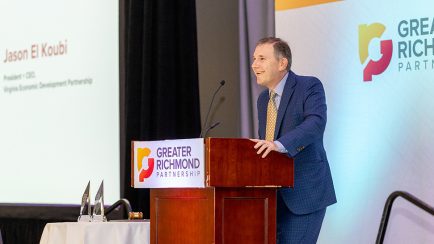
Greater Richmond is playing an outsized role in Virginia’s economic success, according to Jason El Koubi, President and CEO of the Virginia Economic Development Partnership (VEDP), who delivered the keynote address at the Greater Richmond Partnership’s (GRP) Annual Meeting.
Speaking to regional business executives, investors and community leaders, El Koubi described Greater Richmond as a powerful contributor to the Commonwealth’s economic momentum while outlining the opportunities and challenges shaping Virginia’s future competitiveness.
“This is such a special place and it’s a real engine for Virginia,” El Koubi said, recognizing the region where he lives and works.
He also emphasized that successful economic development depends on collaboration among state, regional and local partners, as well as the private sector.
This is truly a team sport… We can do our job great at the state level, but we need the partnership of our localities and our regions to tell the story.”
Jason El Koubi
President and CEO, Virginia Economic Development Partnership
Over the past five years, VEDP has participated in more than 500 economic development project wins across Virginia, representing more than 75,000 new direct jobs and over $100 billion in capital investment.
El Koubi noted that Greater Richmond has captured a disproportionate share of those successes relative to its population and economic size, contributing significantly to statewide job creation and capital investment.
He also emphasized that approximately two-thirds of Virginia’s economic development project wins involve expansions of existing businesses, reinforcing the importance of supporting companies already operating in the Commonwealth.
While billion-dollar announcements often generate headlines, El Koubi explained that a typical economic development project represents approximately 50 jobs and slightly less than $10 million in capital investment.
These investments, large and small, create opportunities that extend beyond the initial announcement, generating lasting economic benefits for communities.
El Koubi highlighted the importance of organizations such as GRP in connecting communities and positioning metropolitan regions for investment.
He noted that 88 percent of Virginia’s jobs are located in metropolitan areas, making regional coordination essential to the Commonwealth’s economic prosperity.
From workforce availability and infrastructure to transportation, cultural amenities and quality of life, many of the assets that make communities competitive operate at a regional rather than individual locality level.
Without organizations that coordinate across jurisdictional boundaries, he explained, communities risk missing opportunities that require a broader regional approach.
His comments reinforced the value of GRP’s public-private partnership serving the City of Richmond and the counties of Chesterfield, Hanover and Henrico.
Among the priorities El Koubi outlined, talent emerged as one of the most consequential for Virginia’s long-term economic success.
“I think the key thing to unlocking prosperity in the future is going to be this fourth thing. It’s going to be about making Virginia America’s top state for talent,” he said.
He identified three essential components of that ambition:
El Koubi emphasized that talent development requires sustained commitment rather than short-term initiatives.
“This is not a four-year problem. This is a 40-year problem. And we need to treat it that way.”
He also called for states and regions to approach talent attraction with the same strategic focus they apply to business recruitment.
Importantly, he noted that successful talent marketing must connect prospective residents to specific regions and communities rather than relying solely on statewide messaging.
The message aligns closely with GRP’s 30 & Thriving strategic plan, which identifies talent as a critical component of Greater Richmond’s long-term competitiveness.
El Koubi identified two additional priorities that will influence Virginia’s ability to compete for future investment: site development and marketing.
He credited Virginia’s investments in site readiness with helping generate more than 12,000 jobs and nearly $10 billion in capital investment in projects involving the state’s site development efforts.
However, he cautioned that development-ready properties are being absorbed faster than new sites are entering the pipeline.
Maintaining Virginia’s competitiveness will require consistent investment in site development, along with strong collaboration among state, regional and local partners to identify future opportunities.
El Koubi also stressed that Virginia must do more to distinguish itself from competing states through strategic marketing.
Although Virginia has a compelling business story, he noted that competing states are investing more heavily in promoting their advantages.
For Greater Richmond, these priorities reinforce the importance of proactively marketing the region’s competitive advantages while ensuring businesses have access to the sites, infrastructure and resources needed to support new investment.
Looking ahead, El Koubi challenged economic development leaders to modernize strategies that have traditionally focused on manufacturing and industrial investment.
While those sectors remain important, he emphasized the need to position Virginia for emerging industries and changes in how businesses operate.
Among the opportunities he identified were artificial intelligence, quantum computing, the space economy, and aerospace and defense innovation.
He also underscored the importance of supporting existing corporate headquarters, insurance companies, software developers and other businesses navigating technological transformation.
Additional priorities included modernizing the business climate, responding to changing corporate real estate needs, supporting innovation districts and addressing housing availability.
El Koubi pointed to North Carolina’s housing development as one factor that has helped accommodate that state’s growth, underscoring the relationship between housing supply, talent attraction and economic competitiveness.
Together, these trends illustrate the increasingly interconnected factors that influence where companies choose to invest and where people choose to build their careers.
Beyond attracting new businesses and investment, El Koubi encouraged economic development organizations to better communicate how their work improves opportunities for residents.
He noted that rapid technological, demographic and economic changes have created uncertainty for businesses, workers and communities.
Economic development leaders, he said, must make stronger connections between business investment, career opportunities and economic mobility.
“We’ve got to make those connections stronger. We’ve got to make them more visible.”
That perspective reflects GRP’s commitment to looking beyond individual project announcements to recognize the lasting impact of economic development on the region’s economy and communities.
As Greater Richmond advances its 30 & Thriving strategic plan, collaboration among public-sector partners, private-sector investors and statewide organizations such as VEDP will remain essential.
El Koubi concluded by reinforcing the importance of continued investment in regional economic development partnerships.
“It’s equally incredibly important that we connect all of that and recognize that the action is happening in our regions.”
His message offered both recognition of Greater Richmond’s achievements and a call to action: sustaining the region’s economic momentum will require continued collaboration, strategic investment and a shared commitment to preparing for the economy of tomorrow.
Watch Jason El Koubi’s full keynote address: Greater Richmond Partnership Annual Meeting.